
Pricing crochet for a craft fair and deciding how much inventory to make are really the same business problem. If you do not know the cost and time behind each design, you cannot set a sustainable price. If you do not record what sells, you cannot know which plushies, colorways or price points deserve another production week.
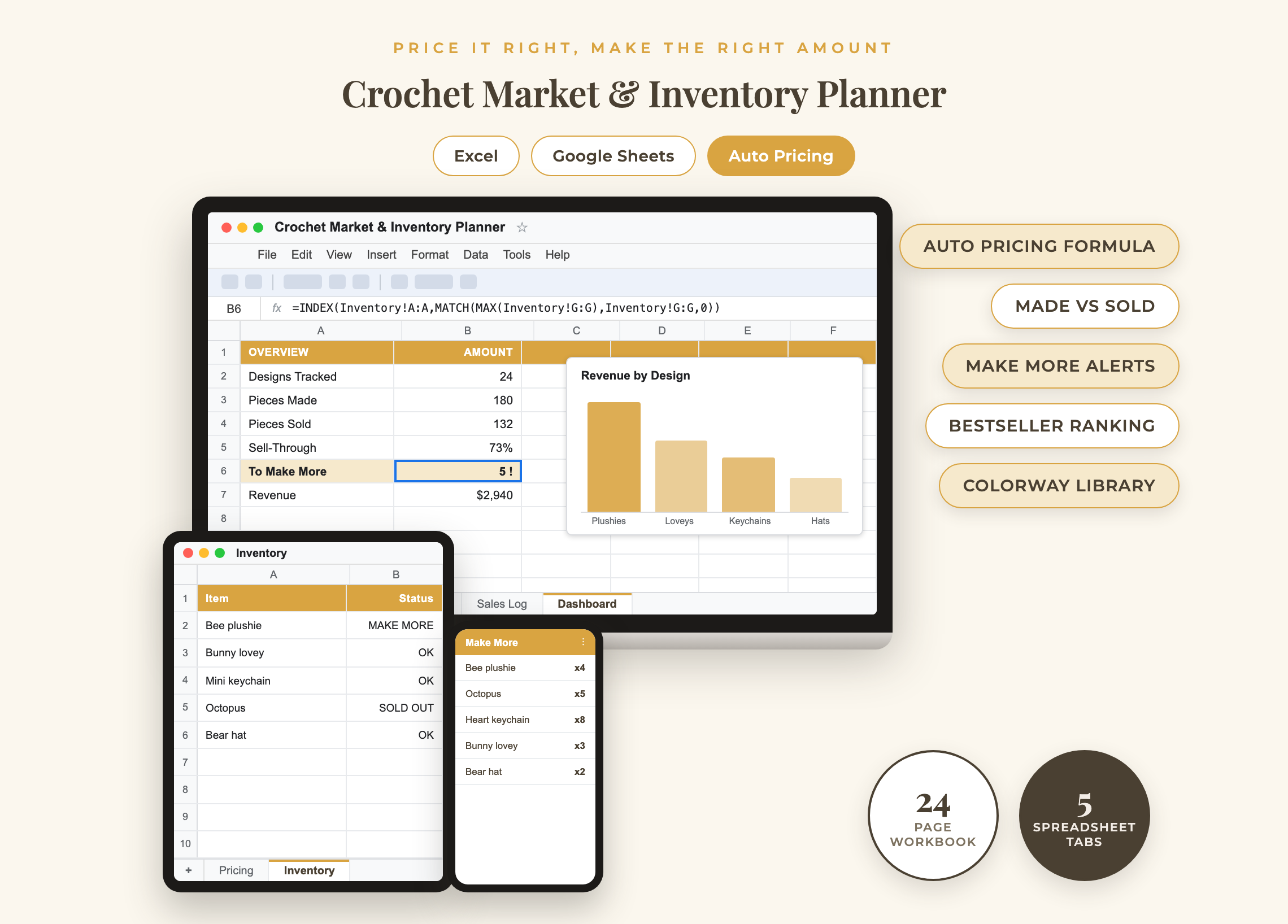
This guide gives crochet and amigurumi sellers a practical system for pricing products, planning market stock and learning from every event. You can build it in your own notebook and spreadsheet, or use our Crochet Market & Inventory Planner on Etsy if you want the formulas and workbook pages ready to use. It is a digital download; no physical item is shipped.
Start With the Real Cost of Each Crochet Item
Yarn is only one part of a handmade product’s cost. A useful cost record separates the expenses you can assign directly to one item from the expenses that support the business as a whole.
- Direct materials: yarn actually used, safety eyes, stuffing, labels, packaging and other components.
- Labor: designing, crocheting, assembly, finishing and packaging time multiplied by the hourly pay you choose for yourself.
- Allocated overhead: equipment, software, market supplies, workspace, marketing and other costs that cannot be assigned neatly to one plushie.
- Selling costs: event fees, payment processing, marketplace charges, discounts and shipping costs you absorb.
A simple starting equation is materials + labor + allocated overhead + selling costs = total item cost. Your final price must cover that total and leave room for profit. A blanket “yarn cost times three” rule can miss the biggest cost in crochet: time.
Etsy’s official pricing guide for sellers also recommends accounting for materials, time, labor and overhead before choosing a sustainable list price. If you sell online as well as in person, check the platform’s current fee information instead of hard-coding an old percentage into your pricing.
Use a Pricing Worksheet Before You Build Stock
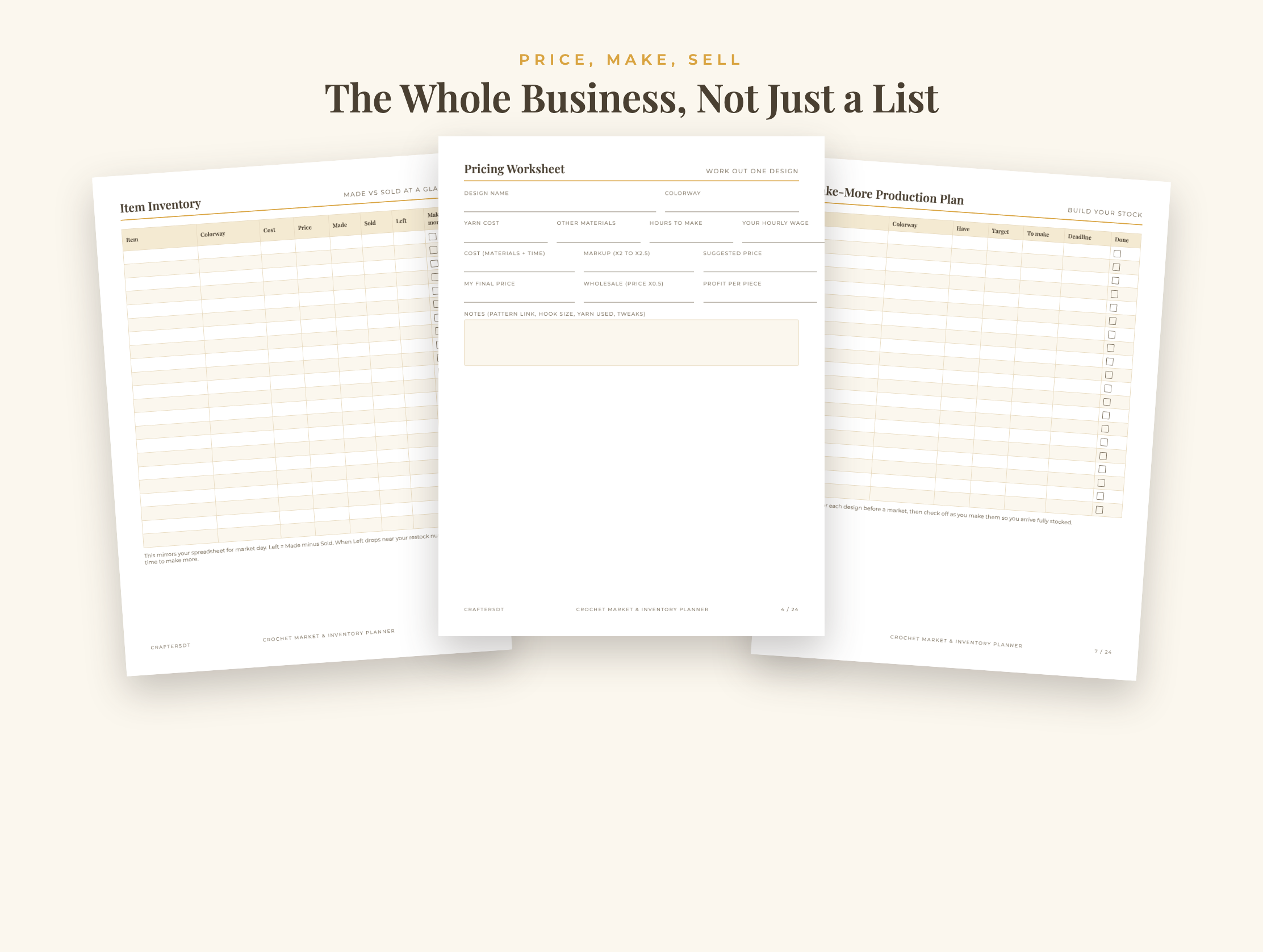
Create one pricing record for every repeatable design and colorway. Record the yarn cost, other materials, typical production time, target hourly pay, total cost and final price. Keep the pattern link, hook size and design changes on that record too; a change in size or construction can change both labor and material cost.
Do not treat a suggested formula as the final answer. Compare the result with your positioning and the market, then decide whether the design works as a product. If shoppers will not support a price that covers the real cost, the answer may be a smaller design, a faster process or a different product—not unpaid labor.
How Much Crochet Inventory Should You Make?
There is no universal number of items that guarantees a successful craft fair. Event size, shopper profile, season, booth location, price range and your own sales history all matter. For a first event, plan a measured test assortment instead of producing a huge quantity based on somebody else’s sales.
- Choose a focused assortment. Make it easy for shoppers to understand what your booth is known for.
- Include different commitment levels. Small add-ons, core products and a few statement pieces can serve different shoppers without requiring arbitrary price bands.
- Set a target by design and colorway. “Make 60 items” is less actionable than a list of exact quantities.
- Protect production time. Prioritize proven sellers and stop adding new designs close to the event.
After the market, your own sales log becomes the best starting point for the next target. It will show which designs sold, which colorways shoppers chose, and what remained.
Track Made, Sold, Left and the Next Restock
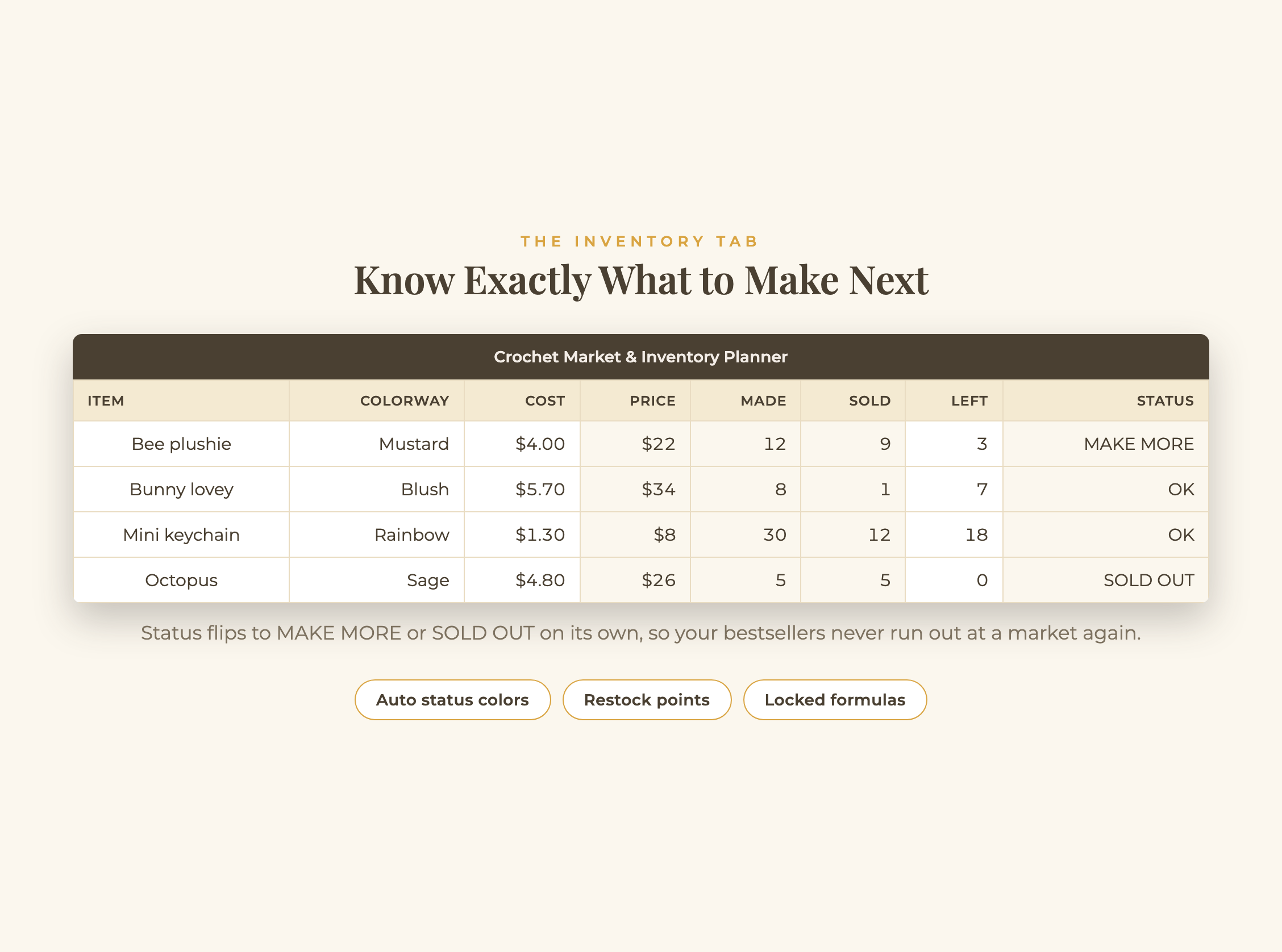
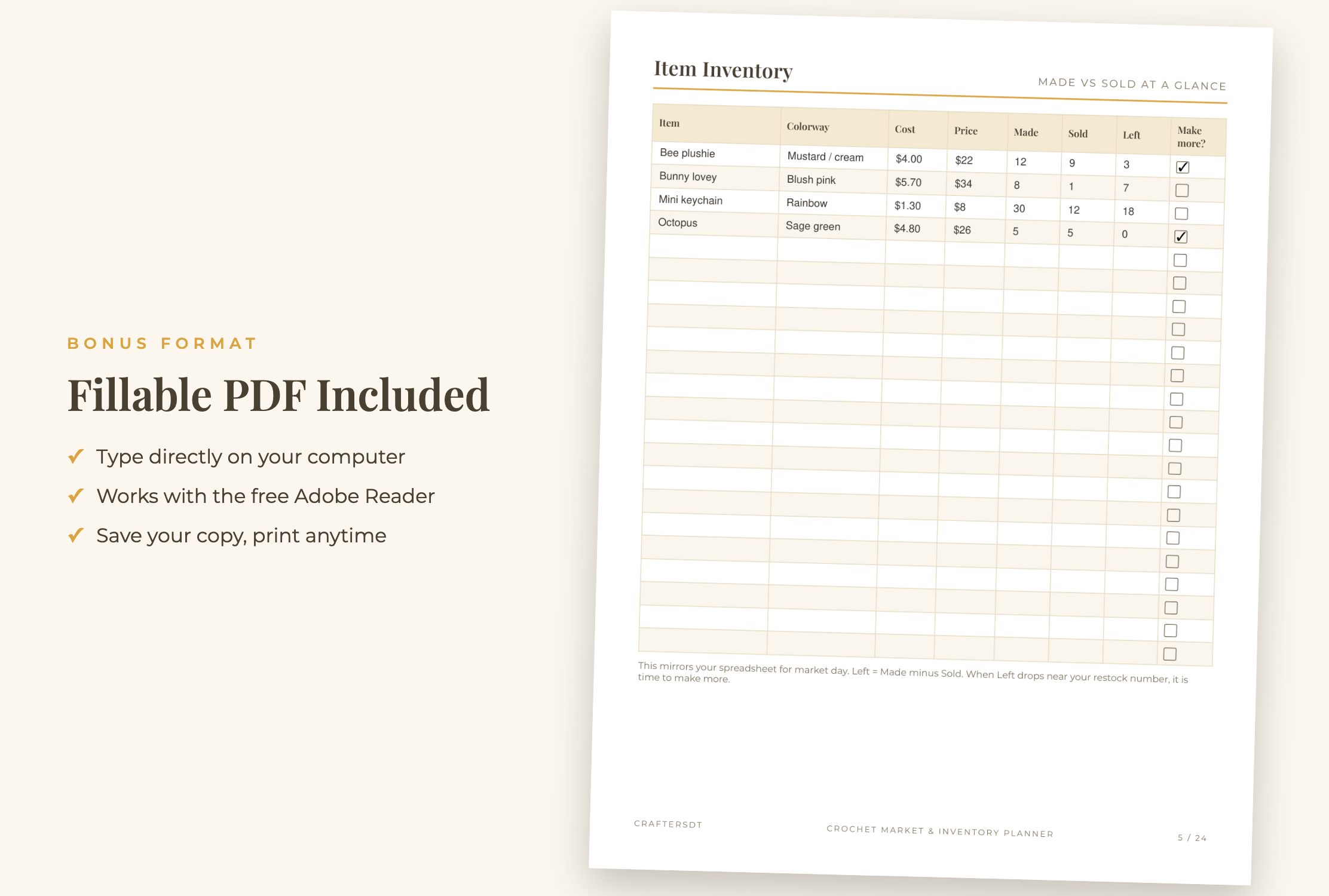
Give every product a consistent name and colorway across pricing, inventory and sales. Then track four basic quantities: how many you made, how many sold, how many remain, and the stock level that should trigger another batch.
Units left = units made − units sold. A restock alert is the next decision, not a promise that the item will sell. Set the threshold high enough to cover the time needed to make another batch before your next event. A quick item may need a lower buffer than a detailed amigurumi design that takes several evenings to replace.
Sell-through rate adds context: divide units sold by units available, then multiply by 100. Compare products from the same event and note whether low sales came from weak demand, poor placement, the wrong season or simply too little shopper traffic. One market is evidence, not a permanent verdict.
Measure Whether the Market Was Worth It
Revenue alone can make an event look better than it was. Record the booth fee, travel, parking, card processing, packaging and other event costs. Then compare those costs with sales and the cost of the items sold. Also record your hours for setup, selling and teardown so you can compare events on more than total revenue.
The U.S. Small Business Administration explains that the break-even point is where total cost and total revenue are equal. For one product, its simplified unit formula is fixed costs divided by price minus variable cost. A mixed crochet booth needs a careful average contribution rather than pretending every item has the same margin.
Finish with a short market debrief: what sold first, what drew attention but did not convert, what shoppers requested, which display area worked and whether you would book the event again. These notes give context to the spreadsheet totals.
Do Not Lose Colorway and Custom-Order Details
Amigurumi buyers often respond to color as strongly as design. A colorway library should record yarn brand, shade or color number, dye lot and where you bought it. That makes a repeat order easier to match and shows which color combinations deserve a place in the next collection.
Keep custom orders separate from market stock. Record the customer, exact request, quote, deposit status, due date, completion and delivery. If a custom piece uses inventory already counted for an event, subtract it immediately so the same item is not promised twice.
📱 Craftino App
Make more crafts like this
1,000+ craft ideas with photo guides & Pro Tips
✓ Step-by-step photo tutorials, nothing left out
✓ Pro Tips for every step
✓ Save crafts & browse fully offline
✓ New ideas added every week


Choose the Right Tool for Each Part of the Workflow
A spreadsheet and a printable workbook solve different problems. Use the spreadsheet for calculations and a live master inventory. Use printable or fillable pages for production planning, market-day tallies, packing, booth setup and notes that are easier to capture away from a computer.
- Spreadsheet: enter costs, prices, quantities made and quantities sold; formulas update totals, status and dashboard information.
- Fillable PDF: type into the workbook pages on a computer and save a separate working copy.
- Printable PDF: print the US Letter or A4 version that matches your paper, then carry individual sheets to production sessions and markets.
What Is Included in the Crochet Market Planner?
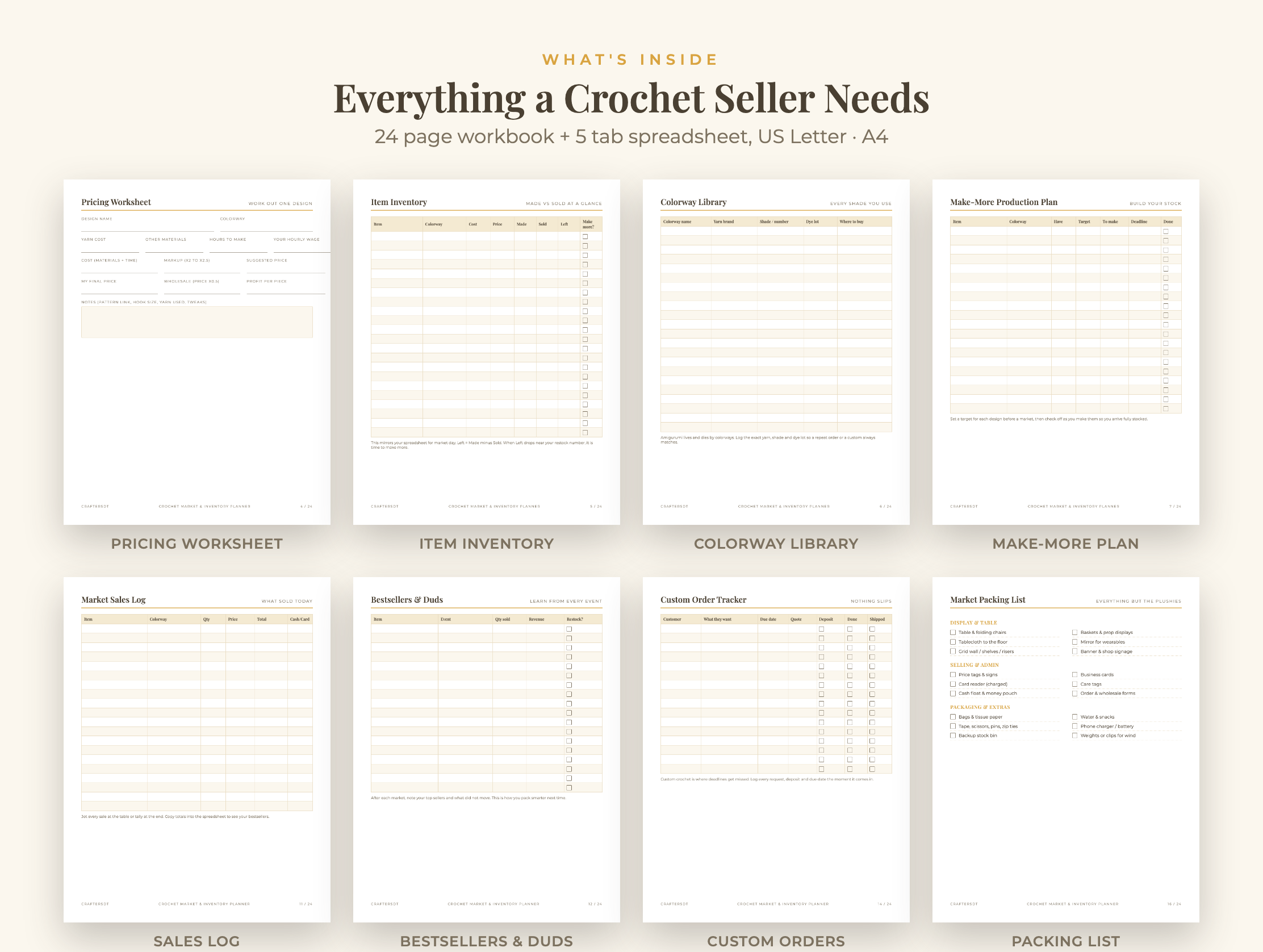
The bundle includes a 24-page printable and fillable workbook plus a five-tab spreadsheet for Excel and Google Sheets. The workbook covers pricing, item inventory, colorways, production targets, a market calendar, two sales-log pages, bestsellers and duds, a market debrief, custom orders, yarn and materials, packing, booth setup and layout, expenses, presentation, care tags and notes.
The spreadsheet includes Read Me, Pricing, Inventory, Sales Log and Dashboard tabs. Formula cells handle pricing calculations, made-versus-sold totals, restock status and summary information. You still choose the inputs, hourly pay, overhead, price and reorder level that fit your business.
A 20-Minute Setup Before Your Next Market
- List your repeatable products. Use one consistent name for each design and colorway.
- Price three core designs first. Record material use and time instead of estimating from memory.
- Count current finished stock. Enter only items that are actually ready to sell.
- Set production targets. Prioritize proven sellers, deadlines and slow-to-replace designs.
- Prepare a fast sales tally. Record item, colorway, quantity, price and payment type during the event.
- Schedule the debrief. Update sold quantities and write observations within 24 hours while the event is fresh.
24-Page Workbook + 5-Tab Spreadsheet
Price, make and restock from one crochet business system
Use the formula-driven spreadsheet for live numbers and the printable or fillable workbook for market preparation.
View the Crochet Market Planner on EtsyRelated Planners
For broader event scheduling, booth preparation and sales planning across different handmade products, see the Craft Fair Vendor Planner. If you need a personal crochet journal for patterns, WIPs, yarn and hooks rather than a selling system, use the Crochet Project Planner.
Crochet Pricing and Inventory FAQ
What formula should I use to price crochet items?
Start by totaling materials, labor, allocated overhead and selling costs. Then choose a price that covers that cost and produces an intentional profit. Test it against your market without treating competitors’ prices or a universal markup as proof that your own costs are covered.
How many crochet items should I bring to a craft fair?
There is no dependable universal quantity. Set targets by design using event size, available production time, price mix and your previous sales. For a first market, use a focused test assortment and record every sale so the next target comes from your own evidence.
What is the difference between inventory and a sales log?
Inventory shows what you made, sold and still have. A sales log records individual market transactions and details such as design, colorway, quantity, price and payment type. Updating inventory from the sales log keeps the remaining quantity accurate.
Does the spreadsheet decide my price automatically?
It calculates from the costs, time, pay and markup you enter, but you remain responsible for those assumptions and the final price. Review marketplace fees, taxes and legal obligations for your location with current official sources or a qualified professional.
Can I use the planner without Excel?
Yes. The spreadsheet file can be uploaded to Google Sheets, and the separate workbook can be printed or used as a fillable PDF. The package includes US Letter and A4 workbook files.
Let Each Market Improve the Next One
The strongest crochet inventory plan is not a giant one-time stock target. It is a repeatable loop: calculate real costs, set intentional prices, make a focused assortment, record sales, review what happened and adjust the next batch. If you want those steps connected in one reusable system, explore the Crochet Market & Inventory Planner on Etsy.

Leave a Reply